

News From The Edge
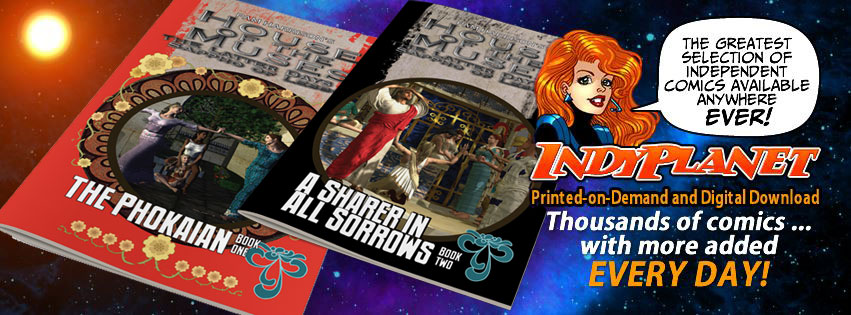
 The award-winning series is on its way back, and nearing resolution! House of the Muses, the recipient of the 2008 Prism Comics Queer Press Grant award is in pre-press and will be released at long last in two 300 page graphic novel collections by the end of 2017.
Back in 2012, we were all left right in the middle of House of the Muses #10 with Dika and Gongyla in prison awaiting trial and execution for the bloody murders of Andromeda and Gorgo, both long-time and mortal enemies of the famed poetess Sappho of Lesbos. But there was more to the story, and at long last readers will thrill to this saga of love and betrayal all the way to its long-awaited conclusion.
 When I first began work on House of the Muses in 2007, the CGI (computer-generated imagery) medium also known as “Poser” comics was still in its infancy. Critics of the medium also used “Poser” in its most derogatory definition in early critiques of my work. To this very day I still get hits on my websites from links on Shadow’s Den: Making Webcomics: What If I Can’t Draw? Over time I as a creator stuck to my guns and set a high bar on creation of artistry in this medium. I would later go on to revive an old science fiction series I created back in 1980, more than thirty years later in 2010.

Work on the new series A Deviant Mind and struggling with details on House of the Muses proved tasking, and so I put House of the Muses on hiatus in 2012. Alas, the story, as well as the burden of unfinished business, continues to haunt me, and so I bring myself back to the task of wrapping these stories and sitting back on my laurels. At least the joke is on Shadow’s Den. I have in my files a number of character sketches and illustrations of all the beloved characters of the House of the Muses series in Art Noveau style, and I will be scanning, editing and coloring those for inclusion in the books.
And now I’m off to work. More on this project as it moves forward.
“You may forget, but I will tell you this: Someone, in some future time, will remember us.” –Sappho of Lesbos, 6th C. B.C.
Discover more from Sword and Labrys Productions
Subscribe to get the latest posts sent to your email.
Tags: Dika, House of the Muses, Sappho


Pam Harrison
From the acclaimed creator of House of the Muses, A Deviant Mind, The Voices Against Bullying Anthology, contributor to Dark Mischief Horror Anthology, Prism Comics’ ALPHABET LGBTQAI Anthology and Chief Editor of ICC Magazine: Pam Harrison is one of the first and best known CGI artists in Independent Comics. Her work with the historical fiction series House of the Muses earned her the 2008 Prism Comics Queer Press Grant for Outstanding Series, and she continues her storytelling in a gripping sci-fi space opera adventure, A Deviant Mind, that far transcends its original LGBT audience. Keep up to date with all her latest news at houseofthemuses.com.



